
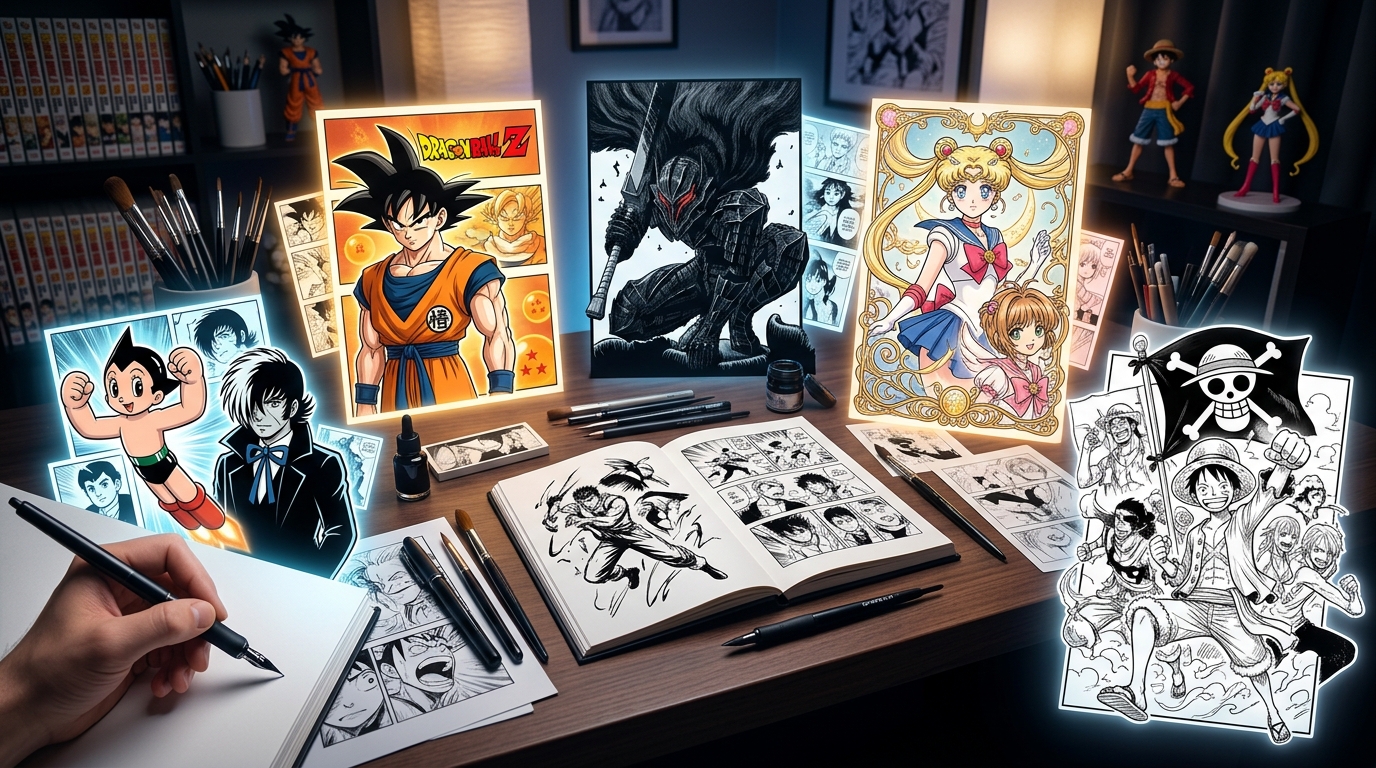
Manga wouldn’t exist as we know it without the visionaries who dared to break conventions. These artists didn’t just draw stories. They created entire worlds, invented techniques still used today, and turned a niche Japanese art form into a global phenomenon worth billions.
The most influential manga artists revolutionised visual storytelling through innovative panel layouts, character design, and narrative techniques. From [Osamu Tezuka](https://en.wikipedia.org/wiki/Osamu_Tezuka)’s cinematic approach to Akira Toriyama’s dynamic action sequences, these creators established the foundation for modern manga and anime. Their work transcends borders, influencing global comics, animation, and popular culture whilst inspiring millions of artists worldwide to pursue their creative visions.
Osamu Tezuka Built the Foundation
Osamu Tezuka earned the title “God of Manga” for good reason. He introduced cinematic techniques to manga in the 1950s, using close-ups, varied panel sizes, and dynamic angles borrowed from film.
Before Tezuka, manga panels were uniform and static. He smashed that mould.
His work on Astro Boy (Tetsuwan Atom) demonstrated how manga could tackle complex themes whilst entertaining young readers. The big-eyed character design he popularised became the blueprint for countless manga and anime that followed.
Tezuka’s influence extended beyond art style. He established the page-count standards and weekly serialisation model that defined the industry. His studio system trained dozens of future legends who would carry his innovations forward.
Phoenix (Hi no Tori) showcased his mature storytelling abilities. This epic spanning thousands of years proved manga could be literature, not just disposable entertainment.
“Manga is virtual. Manga is sentiment. Manga is resistance. Manga is bizarre. Manga is pathos. Manga is destruction. Manga is arrogance. Manga is love. Manga is kitsch. Manga is sense of wonder. Manga is…there is no conclusion yet.” – Osamu Tezuka
Akira Toriyama Mastered Dynamic Action
Dragon Ball changed everything about action manga. Akira Toriyama’s clean linework and kinetic fight sequences set a new standard that artists still chase today.
His panels flow like water. You can feel the speed and impact of every punch.
Toriyama’s genius lies in clarity. Even during the most chaotic battles, you always know exactly what’s happening. His backgrounds stay simple, keeping focus on character movement and expression.
The tournament arc structure he perfected in Dragon Ball became a template copied across countless shōnen series. His influence on One Piece, Naruto, and My Hero Academia is undeniable.
Dr. Slump proved his versatility before Dragon Ball’s success. The comedic timing in those panels demonstrated his understanding of visual rhythm and pacing.
His character designs remain iconic decades later. Goku’s silhouette is instantly recognisable worldwide, a testament to effective visual design.
Rumiko Takahashi Dominated Multiple Genres
Few artists have matched Rumiko Takahashi’s versatility and commercial success. She conquered romantic comedy with Ranma ½, supernatural horror with InuYasha, and slice-of-life comedy with Urusei Yatsura.
Her work appeals to both male and female readers, a rare achievement in manga’s often-segmented market.
Takahashi’s character writing sets her apart. Her protagonists feel like real people with flaws, growth arcs, and genuine chemistry. The romantic tension in her series keeps readers hooked for hundreds of chapters.
She pioneered the harem comedy genre whilst avoiding its worst tropes. Her female characters have agency and personality beyond being romantic interests.
Her productivity is legendary. She maintained multiple serialisations simultaneously whilst maintaining consistent quality. That work ethic inspired generations of manga artists to push their limits.
Naoki Urasawa Elevated Thriller Storytelling
Monster redefined what manga thrillers could achieve. Naoki Urasawa brought cinematic pacing and psychological depth to the medium that rivals any novel or film.
His realistic art style grounds even the most outlandish plots. Every wrinkle and shadow serves the story’s emotional weight.
Urasawa’s panel layouts guide your eye with precision. He knows exactly when to use a full-page spread for maximum impact and when a small panel creates more tension.
20th Century Boys demonstrated his ability to juggle massive casts across complex timelines. Readers stay invested because every character feels essential to the narrative.
Pluto reimagined Tezuka’s Astro Boy stories through a mature lens, proving how manga can reinterpret its own history. This meta-textual approach opened new creative possibilities for the medium.
His influence extends beyond manga into live-action adaptations that actually work. That’s rare and speaks to the strength of his storytelling fundamentals.
CLAMP Revolutionised Team Collaboration
CLAMP proved manga creation didn’t require a lone genius. This all-female collective produced some of the most visually stunning and emotionally complex series in manga history.
Cardcaptor Sakura became a cultural touchstone for magical girl manga. Its fashion-forward character designs and heartfelt storytelling influenced an entire generation.
Their art style evolved dramatically across series. The gothic intensity of xxxHOLiC contrasts sharply with the soft romanticism of Chobits, yet both bear their distinctive mark.
CLAMP’s willingness to experiment with genre conventions kept their work fresh. They blended shōjo and shōnen elements freely, creating stories that defied easy categorisation.
Their crossover universe connecting multiple series anticipated modern cinematic universes by decades. Tsubasa: Reservoir Chronicle brought together characters from their entire catalogue in a mind-bending multiverse adventure.
Kentaro Miura Perfected Dark Fantasy
Berserk stands as one of manga’s greatest artistic achievements. Kentaro Miura’s obsessive attention to detail created a medieval world that feels tangible and terrifying.
His panel compositions are masterclasses in visual storytelling. The contrast between intimate character moments and sprawling battle scenes creates perfect narrative rhythm.
Miura’s linework is legendary. Every suit of armour, every blade of grass receives meticulous attention. That dedication to craft inspired countless artists to raise their own standards.
The Eclipse sequence remains one of manga’s most traumatic and brilliantly executed narrative turns. Miura understood how to build tension across volumes before delivering devastating payoffs.
His character work gave depth to what could have been a simple revenge story. Guts’ psychological journey resonates because Miura took time to show his trauma and growth.
Though Miura passed away in 2021, his influence on dark fantasy manga and anime continues growing. Artists worldwide study Berserk to understand visual storytelling at its peak.
Comparison of Artistic Innovations
| Artist | Key Innovation | Genre Impact | Technical Contribution |
|---|---|---|---|
| Osamu Tezuka | Cinematic panel layouts | Established modern manga structure | Variable panel sizes and angles |
| Akira Toriyama | Dynamic action sequences | Defined shōnen battle manga | Clean linework with motion clarity |
| Rumiko Takahashi | Cross-gender appeal | Unified demographic boundaries | Character-driven long-form storytelling |
| Naoki Urasawa | Psychological realism | Elevated thriller complexity | Precise pacing and atmosphere control |
| CLAMP | Collaborative creation | Genre-blending narratives | Fashion-forward character design |
| Kentaro Miura | Hyper-detailed environments | Dark fantasy standard-bearer | Masterful contrast and composition |
Katsuhiro Otomo Brought Cyberpunk to Life
Akira didn’t just influence manga. It reshaped global perceptions of what animation and comics could achieve.
Otomo’s hyper-detailed urban landscapes set new standards for background art. Neo-Tokyo feels like a character itself, breathing with neon-lit menace.
His panel construction creates cinematic flow that translates perfectly to animation. The famous bike slide scene works because the manga panels already suggested motion and camera angles.
Otomo proved manga could tackle serious science fiction with literary ambitions. His exploration of power, corruption, and youth rebellion resonated globally during the 1980s.
The psychic battle sequences introduced visual metaphors for abstract concepts that influenced countless action series. How do you draw telekinesis? Otomo showed the way.
His influence extends beyond manga into global film and comics. The Wachowskis studied Akira before making The Matrix. That’s cultural impact.
Eiichiro Oda Mastered World-Building
One Piece has been serialised since 1997 without losing steam. That’s unprecedented staying power driven by Eiichiro Oda’s meticulous world-building.
His ability to plant narrative seeds hundreds of chapters before they bloom shows planning that rivals any novelist. Readers trust that every detail matters.
Oda’s character designs are wildly creative. He breaks proportion rules constantly, yet every character remains visually distinct and memorable.
The Straw Hat crew’s dynamics demonstrate his understanding of ensemble casts. Each member gets spotlight moments that advance both character and plot.
His panel layouts can be chaotic, packed with visual information. Yet that density rewards re-reading, as fans constantly discover new background details.
One Piece’s global success helped manga break into mainstream Western markets. Oda’s work proved manga could sustain epic narratives rivalling any Western comic franchise.
Recognising Common Artistic Approaches
These legendary artists share several practices that aspiring creators should note:
- They studied fundamentals relentlessly before developing unique styles
- Each maintained brutal work schedules to meet weekly deadlines
- They weren’t afraid to experiment with genre conventions
- Their character designs prioritised instant visual recognition
- They understood pacing as both art and science
- They created worlds readers wanted to revisit repeatedly
- Their work balanced commercial appeal with artistic vision
Learning from the Masters
Want to understand these artists’ impact? Here’s how to study their work effectively:
- Read their early work to see how they developed their style over time
- Compare their panel layouts to understand different pacing approaches
- Analyse how they handle action versus dialogue-heavy scenes
- Notice their character design evolution across series
- Study how they use backgrounds to establish mood and atmosphere
- Track recurring visual motifs and symbolic elements
- Observe how they balance exposition with visual storytelling
Why These Artists Changed Everything
These creators didn’t just make popular manga. They expanded what the medium could express and who it could reach.
Tezuka proved manga could be art. Toriyama showed it could be a global phenomenon. Takahashi demonstrated its cross-demographic potential. Urasawa elevated its literary credibility. CLAMP reimagined its creative process. Miura perfected its visual craft. Otomo gave it cinematic scope. Oda proved its narrative endurance.
Their innovations became the foundation every modern manga artist builds upon. The panel layouts you see in today’s Jump series? Tezuka pioneered that. The action clarity in battle shōnen? Toriyama set that standard. The psychological depth in seinen manga? Urasawa raised that bar.
These artists transformed manga from post-war entertainment into a global cultural force. Their work inspired anime adaptations that introduced millions to Japanese storytelling. Video games, films, fashion, and music all bear their fingerprints.
Most importantly, they showed that manga could be a legitimate career for serious artists. Before these pioneers, manga was often dismissed as disposable children’s entertainment. They proved it could be literature, art, and commerce simultaneously.
The Legacy Continues Growing
The most influential manga artists created more than memorable stories. They built the language modern manga speaks.
Every time you see a speed line, a dramatic close-up, or a full-page character reveal, you’re witnessing techniques these masters refined. Their influence extends beyond manga into global comics, animation, and visual storytelling.
New artists continue building on their foundations. The current generation of manga creators grew up reading these legends, absorbing their techniques, then adding their own innovations. That’s how art forms evolve.
Understanding these pioneers helps you appreciate modern manga more deeply. You’ll notice the homages, the subversions, and the continued evolution of techniques they pioneered decades ago. Their work remains as relevant today as when it first appeared, because great storytelling transcends its era.